
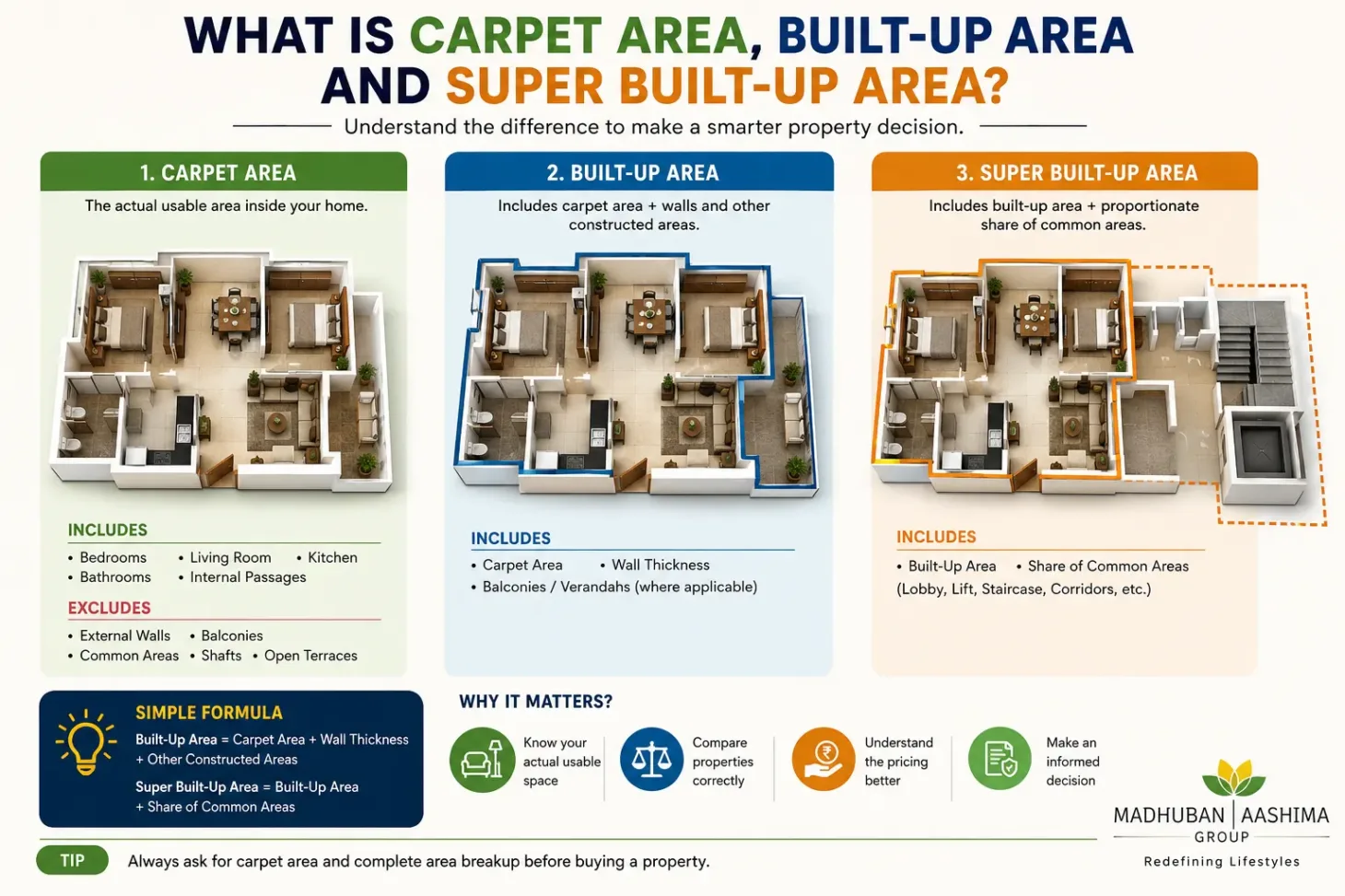
Buying a home is an exciting decision, but understanding property measurements can sometimes be confusing. When you look at a property brochure, you may see terms such as Carpet Area, Built-Up Area, and Super Built-Up Area.
At first, all three may sound similar. However, they represent different measurements of a property.
For example, a builder may advertise a flat as 1,500 sq. ft., but the actual space available for your furniture, daily activities, and living may be much smaller.
This is why every homebuyer should understand the difference between carpet area, built-up area, and super built-up area before booking a property.
In this guide, we will explain each term in simple language.
What is Carpet Area?
Carpet area is the actual usable area inside your home.
Simply put, it is the space where you can place furniture, walk around, and use for your daily activities.
The name “carpet area” comes from the idea that this is the area where you can theoretically lay a carpet.
Carpet Area Usually Includes:
- Bedrooms
- Living room
- Dining area
- Kitchen
- Bathrooms
- Internal passages
- Other usable spaces inside the apartment
Under the RERA definition, the area covered by internal partition walls is also included in carpet area. However, external walls, service shafts, exclusive balconies, verandahs, and open terraces are excluded.
Why is Carpet Area Important?
Carpet area gives you the clearest idea of how much space you can actually use inside your home.
For example, imagine two apartments:
- Apartment A: 800 sq. ft. carpet area
- Apartment B: 700 sq. ft. carpet area
Even if Apartment B has a larger advertised super built-up area, Apartment A may offer more actual living space.
That is why checking the carpet area is important when comparing properties.
What is Built-Up Area?
Built-up area is larger than carpet area.
It generally includes the carpet area along with additional constructed portions of the property, such as the thickness of walls and, depending on how the property is measured and presented, areas such as balconies or verandahs.
Simple Formula:
Built-Up Area = Carpet Area + Area Covered by Walls + Other Constructed Areas
The exact calculation can vary depending on the property’s design and the measurement method used by the developer. Therefore, buyers should always ask for a clear area breakup before making a decision.
Example:
Suppose your apartment has:
- Carpet Area: 800 sq. ft.
- Walls and balcony area: 150 sq. ft.
The approximate built-up area could be:
800 + 150 = 950 sq. ft.
So, the built-up area is larger than the carpet area because it includes additional constructed portions.
What is Super Built-Up Area?
Super built-up area is usually the largest of the three measurements.
It includes the built-up area of your apartment plus your proportionate share of common areas in the building or residential project.
Super built-up area is sometimes also referred to as the saleable area.
Common Areas May Include:
- Entrance lobby
- Common corridors
- Staircases
- Lift areas
- Shared passages
- Other common facilities
The exact components included in super built-up area can vary from one project to another. Buyers should always ask the developer how the super built-up area has been calculated.
Simple Formula:
Super Built-Up Area = Built-Up Area + Proportionate Share of Common Areas
Carpet Area vs Built-Up Area vs Super Built-Up Area
| Area Type | What It Means | Main Purpose |
|---|---|---|
| Carpet Area | Actual usable space inside the home | Helps you understand the real living space |
| Built-Up Area | Carpet area plus walls and other constructed portions | Shows the total constructed area of the apartment |
| Super Built-Up Area | Built-up area plus a share of common areas | Often used for project-level area calculations and marketing |
In simple words:
Carpet Area = Space you actually use
Built-Up Area = Carpet Area + Constructed portions
Super Built-Up Area = Built-Up Area + Share of Common Areas
A Simple Example to Understand All Three Areas
Let’s imagine you are buying an apartment.
The property details are:
Carpet Area: 750 sq. ft.
This is the primary usable space inside your home.
You can use this space for:
- Bedrooms
- Living room
- Kitchen
- Bathrooms
- Internal passages
Built-Up Area: 950 sq. ft.
This may include the carpet area along with walls and other applicable constructed portions.
Super Built-Up Area: 1,200 sq. ft.
This includes the built-up area plus your proportionate share of common areas.
So, although the property may be marketed as 1,200 sq. ft., the actual usable living space may be closer to the carpet area of 750 sq. ft.
This is why buyers should never make a decision based only on the largest area mentioned in an advertisement.
Why Do Property Area Measurements Matter?
Understanding property measurements can help you make a smarter buying decision.
1. Helps You Understand Actual Living Space
The carpet area tells you how much space you will actually have for everyday living.
Before purchasing a property, think about:
- How many bedrooms you need
- The size of your family
- Furniture placement
- Storage requirements
- Future family needs
A larger super built-up area does not always mean a larger usable home.
2. Helps You Compare Properties Correctly
Suppose you are comparing two apartments.
Property A
- Carpet Area: 850 sq. ft.
- Super Built-Up Area: 1,200 sq. ft.
Property B
- Carpet Area: 780 sq. ft.
- Super Built-Up Area: 1,250 sq. ft.
At first glance, Property B may appear larger because of its higher super built-up area.
However, Property A actually provides more usable living space.
This is why comparing carpet area is important when comparing multiple properties.
3. Helps You Understand the Price Better
When discussing property prices, always ask:
“What is the price based on—carpet area, built-up area, or another measurement?”
Understanding the basis of pricing can help you compare the value offered by different properties more accurately.
4. Helps Avoid Confusion During Property Buying
Many first-time homebuyers focus only on the total area mentioned in a brochure.
However, asking for a complete area breakup can give you better clarity.
Before booking a property, ask for:
- Carpet area
- Built-up area, if applicable
- Balcony or terrace details
- Common area details
- Area mentioned in the agreement
- RERA-related project information where applicable
What is RERA Carpet Area?
RERA, or the Real Estate (Regulation and Development) Act, provides a standard definition of carpet area to improve transparency for homebuyers.
Under RERA, carpet area generally means the net usable floor area of an apartment, including the area covered by internal partition walls, while excluding external walls, service shafts, exclusive balconies or verandahs, and exclusive open terraces.
This standard definition helps buyers understand the actual usable area of the property more clearly.
Why RERA Carpet Area is Important
RERA carpet area helps improve transparency because buyers can better understand:
- The actual usable space available
- The property size being disclosed
- Differences between various area measurements
Before purchasing a property, it is always a good idea to review the area details mentioned in official project documents and the sale agreement.
Which Area Should You Check Before Buying a Property?
The most important area to understand for daily living is generally the carpet area because it represents the usable space inside the home.
However, you should not completely ignore the other measurements.
A smart homebuyer should check:
Carpet Area
To understand the actual usable space.
Built-Up Area
To understand the total constructed portion of the apartment.
Super Built-Up Area
To understand how the developer has calculated the total area, including common spaces.
The best approach is to ask for a complete and transparent area breakup before making your final decision.
What is Loading in Real Estate?
The difference between the usable area of an apartment and the larger area quoted after adding common spaces is often referred to as loading.
In simple terms, loading represents the additional area added to account for shared spaces and facilities.
However, the loading percentage can vary significantly depending on:
- Building design
- Number of apartments
- Size of common areas
- Amenities
- Project layout
Therefore, buyers should not assume that every project has the same loading percentage.
Instead, ask the developer for the exact carpet area and a clear explanation of the total area calculation.
How to Compare Two Properties Using Carpet Area
When comparing two properties, follow these simple steps.
Step 1: Check the Carpet Area
Compare the actual usable area of both apartments.
Step 2: Check the Total Price
Look at the complete cost of the property.
This may include applicable charges and other costs.
Step 3: Compare the Layout
A larger carpet area is useful, but a well-designed layout can also make a significant difference.
Check:
- Room sizes
- Living area
- Kitchen layout
- Storage space
- Natural light
- Ventilation
Step 4: Understand the Area Breakup
Ask the developer for a clear explanation of:
- Carpet area
- Balcony area
- Other exclusive areas
- Built-up area, where applicable
- Super built-up area, where applicable
Step 5: Compare Overall Value
The best property is not always the one with the largest advertised number.
Look at:
- Usable space
- Location
- Construction quality
- Amenities
- Project connectivity
- Future value
- Your family’s requirements
Important Questions to Ask a Builder Before Buying a Flat
Before booking a flat or apartment, you can ask the following questions:
What is the exact carpet area of the apartment?
Does the carpet area include internal partition walls?
Is the balcony included separately?
What is the built-up area of the property?
What is the super built-up area?
Which common areas are included in the super built-up calculation?
What is the total property price?
What area measurement is mentioned in the sale agreement?
Is the project registered under the applicable RERA authority?
Asking these questions can help you make a more informed decision.
Common Mistakes Homebuyers Should Avoid
Mistake 1: Looking Only at the Super Built-Up Area
A large super built-up area can make a property appear bigger.
Always check the actual carpet area.
Mistake 2: Comparing Different Area Types
Do not compare:
- One property’s carpet area
with
- Another property’s super built-up area
This is not an accurate comparison.
Always compare the same type of measurement.
Mistake 3: Ignoring the Floor Plan
Numbers alone do not tell the complete story.
Always review the floor plan to understand:
- Room dimensions
- Space utilisation
- Balcony placement
- Passage areas
- Overall layout
Mistake 4: Not Asking for an Area Breakup
Always ask for detailed information instead of relying only on a single number mentioned in a brochure.
Transparency is important when making a major financial decision like buying a home.
Carpet Area, Built-Up Area and Super Built-Up Area: Which One is Best?
There is no single answer because each measurement serves a different purpose.
However, if you want to understand how much space you will actually use, carpet area is one of the most important measurements to check.
Focus on Carpet Area When:
- Comparing usable space
- Planning furniture
- Understanding room sizes
- Comparing different apartments
Check Built-Up Area When:
- Understanding the overall constructed space
- Reviewing property specifications
Understand Super Built-Up Area When:
- Reviewing the project’s area calculation
- Understanding common area allocation
- Comparing how different developers present property size
The best decision is to understand all three measurements rather than focusing on only one.
How Madhuban & Aashima Group Helps Homebuyers Make Informed Decisions
Buying a home is not only about choosing a beautiful property. It is also about understanding important details such as:
- Property location
- Configuration
- Usable space
- Amenities
- Project specifications
- Documentation
- Long-term requirements
At Madhuban & Aashima Group, homebuyers can explore different residential options and understand the features and specifications of a property before making a decision.
Whether you are buying your first home or looking for a property for your growing family, understanding carpet area and other property measurements can help you choose a home that matches your actual space requirements.
Before making a final booking decision, always review the latest project documents, floor plans, specifications, and applicable regulatory disclosures provided for the specific property.
Final Thoughts
Understanding the difference between carpet area, built-up area, and super built-up area is essential for every homebuyer.
The most important thing to remember is simple:
A larger advertised property area does not always mean you are getting more usable living space.
Always check:
- Carpet area
- Area breakup
- Floor plan
- Property price
- Project documents
When comparing properties, compare the same area measurement to get a clearer picture.
A little understanding before buying can help you make a smarter and more confident property decision.
FAQs: Carpet Area, Built-Up Area and Super Built-Up Area
What is the difference between carpet area and built-up area?
Carpet area is the usable space inside the home. Built-up area is generally larger because it includes the carpet area along with applicable wall areas and other constructed portions such as balconies, depending on the measurement method used.
What is the difference between carpet area and super built-up area?
Carpet area represents the usable living space inside the apartment. Super built-up area includes the built-up area along with a proportionate share of common areas such as corridors, staircases, and lift areas.
Does carpet area include the balcony?
Under the RERA definition, exclusive balconies, verandahs, and exclusive open terraces are excluded from carpet area. Buyers should check the property documents for the exact area breakup.
Does carpet area include walls?
Under the RERA definition of carpet area, the area covered by internal partition walls is included, while the area covered by external walls is excluded.
What is considered the actual usable area of a flat?
Carpet area is generally considered the best measurement for understanding the actual usable living space inside a flat.
Why is super built-up area larger than carpet area?
Super built-up area is larger because it may include the built-up area of the apartment along with a proportionate share of common spaces and facilities.
What is another name for super built-up area?
Super built-up area is sometimes referred to as the saleable area.
Should I buy a property based only on super built-up area?
No. You should also check the carpet area because it helps you understand the actual usable space available inside the home.
How do I know the actual size of my flat?
Check the carpet area, review the floor plan, ask for the complete area breakup, and verify the property details mentioned in the official documents and agreement.
Which area should I compare when choosing between two apartments?
For understanding usable living space, compare the carpet area of both apartments. Also compare the total price, layout, location, amenities, and other important factors before making a decision.
📞 Get In Touch:
- 📍 Kolar Road Office: Flat no. 102, Block A-5, Madhuban Heights, Priyanka Nagar, Kolar Road, Bhopal – 462042
- 📍 Hoshangabad Road Office: Plot F3/F2, Second Floor, Aashima Divine City Commercial Complex, Near Pebble Bay, Hoshangabad Road, Bhopal
- 📞 +91-9329147375
- 📧 infomadhubangroup@gmail.com
- 🌐 madhubanaashimagroup.com



Add comment