
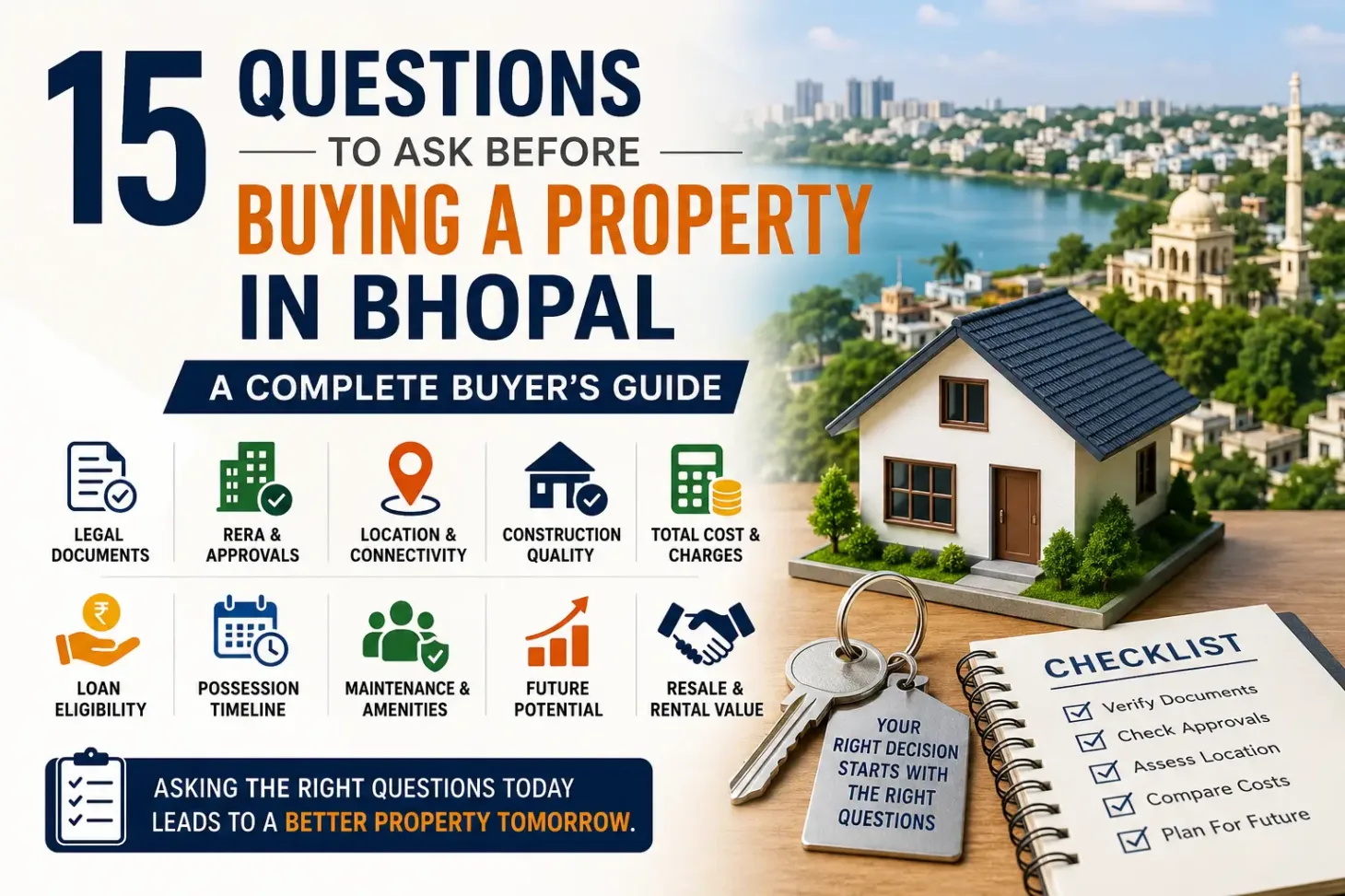
Buying a property in Bhopal is a major financial decision. Whether you are planning to buy a flat, residential plot, independent house, or a property for investment, it is important to look beyond the price.
A property may look perfect during the first visit, but there can be important questions about documents, approvals, location, construction quality, additional charges, possession, and future development.
That is why asking the right questions before making a booking or signing an agreement can help you make a safer and more informed decision.
In this guide, we have listed 15 important questions to ask before buying a property in Bhopal, along with simple explanations of why each question matters.
Quick Answer: What Should You Check Before Buying Property in Bhopal?
Before buying a property in Bhopal, check the total cost, property ownership, legal documents, RERA status where applicable, project approvals, builder reputation, location, construction quality, possession timeline, maintenance charges, loan options, resale potential, nearby infrastructure, and future development plans.
Do not make your decision only because of a low price or attractive offer. A good property should be legally clear, financially suitable, properly approved, and located in an area that matches your lifestyle or investment goals.
15 Important Questions to Ask Before Buying a Property in Bhopal
1. What Is the Total Cost of the Property?
The first question should not simply be, “What is the property price?”
Instead, ask:
“What will be my total cost after including all applicable charges?”
The advertised property price may not always represent the final amount you need to pay.
Depending on the property, additional expenses can include:
- Stamp duty
- Registration charges
- GST, where applicable
- Parking charges
- Maintenance deposits
- Club or amenity charges
- Legal and documentation expenses
- Home loan processing charges
- Interior and renovation costs
- Other applicable project charges
Ask the seller or developer for a complete cost sheet in writing before making a financial commitment.
Why Does This Matter?
A property that looks affordable initially may become expensive after adding other costs. Knowing the complete cost helps you compare different properties properly.
2. Who Is the Legal Owner of the Property?
Before buying any property, ask:
“Who legally owns this property?”
The seller should be able to provide documents that establish ownership.
For a resale property, check the ownership history and relevant title documents. If there are multiple owners, all necessary parties should be properly involved in the transaction.
You should also be careful when dealing with someone selling property through a power of attorney or other representative arrangement.
Why Does This Matter?
A property with unclear ownership can create serious problems later. Before paying a large amount, consider getting the documents checked by a qualified property lawyer.
3. Are All Property Documents Clear and Available?
Ask:
“Can I see and verify all important property documents?”
Depending on the type of property, documents may include:
- Title deed
- Sale deed
- Previous ownership documents
- Encumbrance-related records
- Property tax receipts
- Approved layout or building plan
- Relevant development permissions
- Possession or completion-related documents, where applicable
- Other project approvals
For plots, additional checks may be required depending on the land and development involved.
Why Does This Matter?
Documents are one of the most important parts of a property transaction. Never rely only on verbal assurances.
4. Is the Property RERA Registered?
If you are considering a real estate project that falls under the applicable RERA requirements, ask:
“What is the RERA registration number of this project?”
You can verify the project details through the relevant official RERA records.
Check information such as:
- Project registration
- Promoter details
- Approved project information
- Proposed completion timeline
- Project-related disclosures
Why Does This Matter?
RERA registration can provide buyers with important project information and regulatory transparency. However, RERA registration should be treated as one part of your overall due diligence, not as the only property check.
5. Does the Property Have the Required Approvals?
A property should have the approvals and permissions applicable to its type and location.
Ask:
“Which authority has approved this project or property?”
For a residential project, relevant approvals may depend on the project, land use, development rules, and local authorities.
For plots, buyers should pay particular attention to whether the layout and development have the required approvals.
Why Does This Matter?
A low-priced property is not a good deal if there are problems with its legal status or required permissions.
6. What Is the Exact Location of the Property?
Do not judge a property only by its address or the name of the area.
Ask:
- What is the exact location?
- How far is it from the main road?
- Is the approach road developed?
- What is the road width?
- Is public transport available?
- Are schools and hospitals nearby?
- Are markets and daily-use stores easily accessible?
In Bhopal, properties in areas such as Hoshangabad Road, Kolar Road, Bawadiya Kalan, Katara Hills and other developing locations can have very different surroundings and connectivity.
Why Does This Matter?
A good location should work for your current needs as well as your future plans.
7. What Is Available Near the Property?
Location is not just about the property itself. You should also check the surrounding neighbourhood.
Ask:
“What facilities are available within a practical distance?”
Look for:
- Schools
- Colleges
- Hospitals
- Shopping areas
- Banks and ATMs
- Restaurants
- Public transport
- Parks
- Workplaces
- Main roads
- Other essential services
If you are buying a home for your family, visit the area at different times of the day.
Why Does This Matter?
A beautiful home can become inconvenient if everyday facilities are too far away.
8. What Is the Construction Quality Like?
If you are buying a flat or house, don’t focus only on the exterior appearance.
Ask:
“What materials and specifications are being used in construction?”
Check:
- Structure and construction quality
- Flooring
- Doors and windows
- Electrical fittings
- Plumbing
- Bathroom fittings
- Kitchen specifications
- Paint quality
- Water supply
- Common areas
- Lift and safety systems, where applicable
For a ready property, inspect the property personally. For an under-construction project, compare the promised specifications with the agreement and project information.
Why Does This Matter?
Good construction quality can reduce future repair expenses and make the property more comfortable to live in.
9. What Is the Possession or Completion Timeline?
If the property is under construction, ask:
“When is the expected possession date?”
Also ask:
- What is the construction status?
- What is the promised completion timeline?
- What happens if possession is delayed?
- Which documents will be provided at possession?
- What are the payment milestones?
Avoid relying only on verbal promises. Look at the relevant agreement and official project information.
Why Does This Matter?
A delayed project can affect your finances, especially if you are paying rent while also managing home-loan payments.
10. What Are the Maintenance Charges?
Ask:
“How much will I have to pay for maintenance?”
Depending on the property, charges may cover:
- Security
- Common-area electricity
- Lift maintenance
- Cleaning
- Landscaping
- Clubhouse or amenities
- Repairs of common facilities
- Other society or association expenses
Ask whether the charges are monthly, quarterly, yearly, or based on another structure.
Why Does This Matter?
Maintenance is a recurring expense. It should be included in your long-term budget before buying the property.
11. Is the Property Eligible for a Home Loan?
If you need financing, ask:
“Can this property be financed by a bank or housing finance company?”
You can check whether established financial institutions are willing to finance the property, but remember that loan approval is not a substitute for your own legal verification.
Also compare:
- Interest rates
- Loan tenure
- Processing fees
- Prepayment conditions
- EMI
- Down payment requirement
Why Does This Matter?
A suitable home loan can make property ownership easier to manage financially.
12. What Is the Current Market Price in This Location?
Never accept the first quoted price without comparison.
Ask:
“How does this property’s price compare with similar properties nearby?”
Compare properties based on:
- Location
- Property size
- Construction quality
- Amenities
- Age of property
- Road connectivity
- Development level
- Builder reputation
- Legal and approval status
Do not compare two properties only on price per square foot. A cheaper property may have fewer amenities, weaker connectivity, or additional costs.
Why Does This Matter?
Understanding the local market helps you negotiate better and avoid overpaying.
13. What Is the Future Development Potential of the Area?
If you are buying property as a long-term investment, ask:
“What could change around this property in the next 5–10 years?”
Look at factors such as:
- Road development
- New commercial areas
- Schools and colleges
- Hospitals
- Public infrastructure
- Employment opportunities
- Residential development
- Connectivity improvements
However, do not make an investment decision based only on rumours about future projects. Verify important claims wherever possible.
Why Does This Matter?
Future development can influence the demand, convenience, and resale prospects of a property.
14. What Are the Resale and Rental Prospects?
Even if you are buying a home for personal use, it is useful to think about the future.
Ask:
“If I need to sell or rent this property later, will there be demand?”
Consider:
- Location
- Connectivity
- Nearby employment centres
- Schools and hospitals
- Property type
- Local rental demand
- Quality of the project
- Future development
- Availability of similar properties
Why Does This Matter?
Life circumstances can change. A property with reasonable resale and rental potential can provide greater financial flexibility.
15. Is the Property Right for My Long-Term Needs?
Finally, ask yourself:
“Am I buying this property because it actually suits my needs, or because I am attracted by the offer?”
Think about:
- Your current budget
- Family size
- Future family requirements
- Daily travel
- Lifestyle
- Investment goals
- Loan affordability
- Maintenance costs
- Long-term location preference
A property can be legally sound and reasonably priced but still be wrong for you.
Why Does This Matter?
The best property is not necessarily the most expensive or most attractive one. It is the one that fits your budget, requirements, location preference, and long-term plans.
Property Buying Checklist for Bhopal
Before making your final decision, go through this quick checklist:
- Check the total property cost.
- Verify ownership.
- Review important property documents.
- Check applicable RERA registration.
- Verify required approvals.
- Visit the location personally.
- Check nearby facilities.
- Inspect construction quality.
- Confirm possession or completion timeline.
- Understand maintenance charges.
- Compare home loan options.
- Compare local property prices.
- Research future development.
- Consider resale and rental demand.
- Make sure the property fits your long-term needs.
Common Mistakes to Avoid When Buying Property in Bhopal
Choosing Only on the Basis of Low Price
A low price may look attractive, but always understand why the property is cheaper.
Paying a Large Amount Without Checking Documents
Do your basic legal and document checks before making a major financial commitment.
Ignoring Additional Charges
Always ask for a complete cost sheet instead of calculating only the advertised price.
Not Visiting the Property
Photos and videos cannot always show the actual road, surroundings, traffic, noise, drainage, or neighbourhood.
Depending Only on Verbal Promises
Important promises about price, possession, specifications, amenities, or other terms should be properly documented.
Ignoring Future Requirements
Think about how your family and financial needs may change over the next few years.
How to Choose the Right Property in Bhopal
Choosing the right property becomes easier when you follow a simple process.
Step 1: Decide Your Budget
Calculate how much you can comfortably spend, including the down payment, loan EMI, registration, applicable taxes, maintenance, interiors, and other costs.
Step 2: Decide What Type of Property You Need
Decide whether you want a flat, residential plot, independent house, or property mainly for investment.
Step 3: Shortlist Suitable Bhopal Locations
Compare locations based on connectivity, infrastructure, daily facilities, development, and your personal requirements.
Step 4: Compare Multiple Properties
Do not make a decision after seeing only one property. Compare price, location, specifications, approvals, amenities, and overall value.
Step 5: Visit the Shortlisted Properties
A physical visit can help you understand the actual property and its surroundings.
Step 6: Check Documents and Approvals
Review the relevant legal documents, project information, and applicable approvals before making a major payment.
Step 7: Calculate the Complete Cost
Ask for a detailed cost sheet so there are no unexpected financial surprises later.
Step 8: Compare Financing Options
If you need a home loan, compare interest rates, processing fees, tenure, EMI, and other loan terms.
Step 9: Review the Agreement Carefully
Read the agreement and understand payment schedules, possession terms, specifications, cancellation conditions, and other important clauses.
Step 10: Make the Final Decision
Once your financial, legal, technical, and location checks are complete, make your final decision without unnecessary pressure.
Final Thoughts
Buying property in Bhopal can be an exciting step, whether you are purchasing your first home or making a long-term investment. But a property purchase should never be based only on an attractive price, impressive advertisement, or pressure to book quickly.
The right questions can help you understand the legal status, actual cost, location, construction quality, approvals, future potential, and overall suitability of the property.
Before signing anything, take your time, compare your options, verify important documents, and seek professional legal or financial advice where necessary.
Remember: the goal is not simply to buy a property. The goal is to buy a property that is legally sound, financially manageable, and suitable for your future.
FAQs: People Also Ask About Buying Property in Bhopal
What should I check before buying a property in Bhopal?
You should check the property’s ownership, legal documents, applicable RERA registration, required approvals, total cost, location, construction quality, possession timeline, maintenance charges, and future development potential.
Which documents should I check before buying property in Bhopal?
Depending on the property type, important documents can include the title deed, sale deed, previous ownership records, applicable encumbrance-related records, property tax receipts, approved plans or layouts, and relevant permissions or approvals.
How do I verify whether a property is legally approved in Bhopal?
Ask the seller or developer for the relevant approval and project documents, then verify them with the appropriate government or regulatory authority. For applicable projects, you should also check the official RERA registration details.
Is RERA registration important when buying a property in Bhopal?
Yes, where RERA applies, checking the project’s registration and disclosed information can help a buyer understand important project details. However, buyers should still conduct broader legal, financial, and technical due diligence.
What is the biggest mistake to avoid when buying property?
One of the biggest mistakes is making a payment before properly checking the property’s documents, ownership, approvals, total cost, and agreement terms.
How much should I budget for buying a property?
Your budget should include more than the property’s advertised price. Consider the down payment, loan EMI, registration and applicable government charges, taxes where applicable, parking or other project charges, maintenance, interiors, and other transaction costs.
Should I buy a flat or plot in Bhopal?
It depends on your goal. A flat may be suitable if you want a ready living space with amenities, while a plot may be suitable if you want land ownership and plan to construct later. Compare location, budget, approvals, development, and long-term goals before deciding.
Which areas of Bhopal are good for buying property?
The right area depends on your budget and purpose. Locations such as Kolar Road, Hoshangabad Road, Bawadiya Kalan, Katara Hills and other developing parts of Bhopal offer different property types and connectivity options. Always evaluate the specific project and surrounding infrastructure rather than choosing an area only by name.
How can I check whether a property has a clear title?
Ask for the property’s ownership documents and have them reviewed through an independent property lawyer or qualified legal professional. Title verification is especially important before making a major payment.
Should I visit a property before buying it?
Yes. A physical visit can help you evaluate the actual location, approach road, surroundings, construction quality, traffic, noise, water supply, amenities, and neighbourhood.
What questions should I ask a builder before buying a flat?
Ask about the project’s approvals, RERA registration where applicable, total cost, specifications, possession timeline, maintenance charges, amenities, payment schedule, cancellation terms, and documentation.
Is buying property in Bhopal a good investment?
It can be, but the answer depends on the specific property, location, purchase price, legal status, infrastructure, demand, and your investment timeline. Do not assume that every property will automatically appreciate.


Add comment